



 Sign In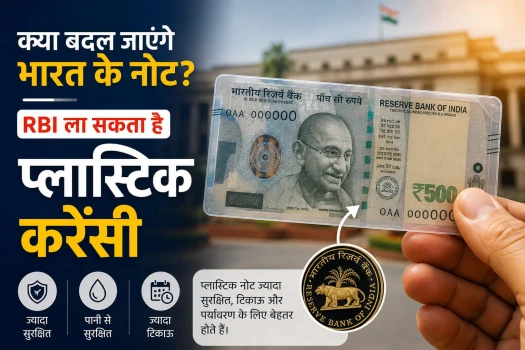
Plastic Currency
Will India Introduce Plastic Currency? Everything You Need to Know
India has seen many changes in its currency over the years—from new security features to redesigned banknotes. Recently, discussions about plastic (polymer) currency notes have gained attention again. But is India really planning to replace paper notes with plastic ones? Let's understand the facts.
What is Plastic Currency?
Plastic currency, also known as polymer banknotes, is made from a special type of plastic instead of traditional cotton-based paper. These notes are stronger, waterproof, and more durable than paper notes.
Countries like Australia, Canada, New Zealand, the UK, Singapore, and Vietnam already use polymer currency successfully.
Why is RBI Considering Plastic Notes?
The Reserve Bank of India (RBI) has explored the possibility of introducing polymer notes because they offer several benefits:
Longer Lifespan: Plastic notes last 2–3 times longer than paper notes.
Better Security: Advanced security features make counterfeiting more difficult.
Water & Dirt Resistant: They remain clean and undamaged even after heavy use.
Lower Long-Term Cost: Although production costs are higher initially, they save money over time due to their durability.
Environment Friendly: Polymer notes can be recycled after use.
Has RBI Confirmed Plastic Currency?
As of now, RBI has not officially announced a nationwide rollout of plastic currency notes. While pilot projects and discussions have taken place in the past, India's current currency continues to be made primarily from cotton-based paper.
Any major decision regarding plastic currency will be officially communicated by the RBI and the Government of India.
Challenges of Introducing Plastic Notes
Despite the advantages, there are some challenges:
Higher manufacturing cost initially.
New printing technology and infrastructure are required.
Public awareness and adaptation.
Recycling systems need to be developed.
What Would It Mean for Citizens?
If polymer notes are introduced:
Existing currency will continue to remain valid until officially replaced.
There is no need to exchange notes immediately.
Daily transactions will continue as usual during any transition period.
Final Thoughts
Plastic currency has the potential to make India's banking system more secure, durable, and cost-effective in the long run. However, there is currently no official confirmation that India is replacing all paper notes with plastic currency. Citizens should rely only on announcements made by the Reserve Bank of India (RBI) and avoid believing unverified social media posts.
Stay informed with trusted news and official RBI updates for the latest developments.
Share This Post
Top Categories
Popular Tag
Recently Post

How Freshers Can Get Their First Job Without Experience on StaffW...
Sep 8, 2026
How Gen Z Is Changing the Workplace in 2026
Aug 4, 2026
AI Will Replace Jobs? Here's the Truth in 2026
Jul 25, 2026
How Freshers Can Get Their First Job Without Experience
Jul 23, 2026
Blue Collar vs White Collar Jobs: What's the Difference?
Jul 16, 2026
StaffWallah
Jul 15, 2026
Meta Announces Paid Plans for Instagram and WhatsApp
May 28, 2026
Big Update on Rajasthan 4th Grade Recruitment 2024
May 23, 2026
Indian Railways: The Lifeline of India
May 22, 2026
Why Skill-Based Education Matters in 2026
May 21, 2026
How AI-Powered Hiring is Changing Recruitment in 2026
May 20, 2026
The Future of Hiring in India: How Digital Recruitment Platforms...
May 16, 2026
NEET UG 2026 Exam Reschedule: What Students Need to Know
May 15, 2026
JOB FAIT
Dec 24, 2025Related Post
Artificial Intelligence (AI) is changing the way we work. From customer support chatbots to smart software that can writ...
Read More
In today’s competitive world, education is no longer limited to books and classroom learning. Companies now look for can...
Read More
How AI-Powered Hiring is Changing Recruitment in 2026In today’s fast-moving job market, companies are no longer relying...
Read More